Donate to Red Cross Japan

The earthquake victims would appreciate your help more than you'll ever know(more resources can be found here).

Monday, October 25, 2010

Lesson 3.4: Money, Japan and You

One thing you're gonna learn about Japan very quick is that getting around there requires a lot of knowledge of money numbers, along with having lots of traveling-around-buying-useless-crap-you-want money-which I always ration into my own trips and travels. With that in mind, let's begin learning the basic ways to talk about the bigger chunks of change you'll be using in your travels.

百《ひゃく》、二百《にひゃく》、三百《さんびゃく》、四百《よんひゃく》、五百《ごひゃく》、六百《ろっぴゃく》、七百《ななひゃく》、八百《はっぴゃく》、九百《きゅうひゃく》(Can't read it?)

[100, 200, 300, 400, 500, 600, 700 ,800, 900]
This kinda money'll probably buy you a meal at a fast food joint or a neat little toy from some vending machine, but knowing the average person traveling to Japan what you desire will undoubtedly climb into the 1000+ or even 10,000+ yen range. Here are the kind of numbers you'll most likely come across as you roam around the various stores.


千《せん》、二千《にせん》、三千《さんぜん》、四千《よんせん》、五千《ごせん》、六千《ろくせん》、七千《ななせん》、八千《はっせん》、九千《きゅうせん》

[1000, 2000, 3000, 4000, 5000, 6000, 7000, 8000, 9000]


This is the most common range of numbers you'll see when you're shopping around the cities, and the only things I know more expensive than 9000 are specialty goods, collectors editions of stuff and so on(the stuff I know a lot of you want, but might not be able to afford without donating a kidney or first born child). Now, before we go higher up the ranks of spending, I think it's time for a bit of a break to review the money system, as well as how to recite our larger chunks of change.

Wednesday, October 13, 2010

Lesson 3.3: The Numbers Game: Counting From 1-99 in Japanese

There are many things we learn as kids that, as we grow, we take for granted, one of those being the ability to count numbers.As I'm sure you can wrap your head around, this is also important in learning Japanese, so let's start with the numbers we learned when we were first in diapers, 1-10

一《いち》[1]、 二《に》[2]、 三《さん》[3]、 四《よん》[4]、 五《ご》[5]、 六《ろく》[6]、 七《なな》[7]、 八《はち》[8]、 九《きゅう》[9]、 十《じゅう》[10](Can't read it?)

To help you remember them in Japanese, try counting them on your hands(or anything that can amount to ten, at this point). When you feel you have them down solid, count these numbers in Japanese:

1, 2, 3, 4, 5, 6, 7, 8, 9, 10


Did you count them well? You did? Very good! Once you have those down pat, learning numbers 11-99 is a snap.


Making them is as easy as 十[number]for 11-19(IE 十+八=the word for the number 18, 十八《じゅうはち》) and [number]十[number] beyond that up to 99(IE 四+十+二= the word for 42, 四十二《よんじゅうに》)

To see this in motion, observe these examples:

十三《じゅうさん》
[13]

五十《ごじゅう》
[50]<

九十八《きゅうじゅうはち》
[98]

Get the mechanics down and you'll know how to count up to 99 in Japanese in no time. Of course, as should be common knowledge by now, many things in Japan cost more than 99 yen. The question is, how much more?(short answer: a whole lot, and you'll some of see those numbers in detail next post)

Monday, September 27, 2010

Lesson 3.2: Being Specific

If you've ever asked someone for directions when you have no clue what the place looks like, you'd probably get super pissed when they just point to something in the distance and say "Over there". Since I'm assuming you'll want a better understanding of your path, the knowledge of what it is in Japanese will be needed. To start, let's work on your general sense of presence:

前《まえ》(Can't read it?)
[front]

後《うし》ろ
[back]

上《うえ》
[up]

下《した》
[down]

左《ひだり》
[left]

右《みぎ》
[right]

If it helps, look around and point out each place in Japanese so it better sticks(or if you have a box, write the different directions on it). On the off chance, someone ever asks you for some directions, one helpful phrase may be:

"(place)の(direction)"
[(direction) of the (place)]

So if you want to tell a friend you're in front of the McDonald's, you can say "マクドナルドの前"At times, however, there may be other words that may help you find the right distance between you and your desired destination:

反対《はんたい》
[opposite]

向い《むかい》
[across the street]

外《そと》
[outside]

中《なか》
[inside]

間《あいだ》
[between]

近《ちか》く
[nearby(meaning you can see it, but not quite touch it yet)]

側《そば》
[right near(as in close enough to touch, or taze)]

横《よこ》
[next to something different(like a piece of pizza near a small tub of ranch)]

隣《となり》
[neighboring something similar(1 house near another, 1 seat near another, etc )]

間 is used when describing when a location is between two others. Take for example this sentence:

(place)は博物館《はくぶつかん》と駅《えき》の間があります
[(place)is between the museum and the station]

Thursday, September 23, 2010

Lesson 3.1: Finding Your Way 'Round

Although everyone knows what happens when you assume, I'm sure many of you reading this many want to visit the island nation at some point in your lives so you can apply your knowledge of the language and culture, regardless of how much or how little you know. If you've ever traveled some place unfamiliar, like, say, a restaurant your friend said you gotta try that's tucked away among a mass of grey brick boxes and neon, you'll soon realize that a key piece of knowledge is how to ask for directions; for a place with as many grey brick boxes and neon as the cities of Japan, this is especially important to have with you.

Travel guides and phrase books do help, but I wouldn't rely too heavily on them, as they can and will get lost in the shuffle of going place to place to try and fit in as much as one trip allows. So if wanna you know which way leads to what you wanna see, set your pride aside, humble up and get ready to ask some directions. When the time comes, find someone friendly looking(gut instincts should be trusted on this part), approach and say the following:

失礼《しつれい》しますが 。。。(Can't read it?)
(Excuse me, but...)

To indicate you're looking for help, follow it up with this phrase:

助《たす》けてくれませんか。
(Could you lend me a hand with something?)
[Note: you can also use 助けて by itself to request assistance, such as when you see someone suddenly having a seizure/choking/going through other tough stuff, and need immediate help]

If you're not lucky, they won't know enough English/have the time to help you out and will either wave their hand in front of their face (like this) or say something among the lines of 難《むずか》しいけど。(It's a bit tough for me) or いそがしいけど。(I'm busy right now), or anything else, really, before they move on, implying that you gotta keep it moving and find someone else.

However, if they don't turn you down, ask one of the following:

 "(place) はどこですか。[note: since はis used as a particle in this instance, it's pronounced like 'わ'. More on this later]"
(where is [place]?)

Or

"(place)はどこでが有《あ》りますか。"
[where is (place) at?]

Tuesday, September 7, 2010

Lesson 2.5:促音(そくおん)Sokuon

In learning about Japan you've undoubtedly come across things and places with a double vowel in their name(One famous example being Hokkaido). How is that rendered in 仮名(Can't read it?), you may ask? With the help of a small つ 仮名, the term for it being 促音. It signifies a brief pause in speech while saying the word(Much like in the English words Poppa or Rabbit)-the technical term being a Germinate Consonant;the more proficient you are at speaking Japanese, the briefer it'll be  Let's take the name for an archetype in most anime-type stories as an example of how it's written:


つんでれっこ


*what a female is named, when they have a tough outer shell, but a tender inner being, closer to when we call a tough looking person a big softie*

It'll sound different depending on what 仮名 follows it(such as in the words 出席《しゅっせき》-the word for attendance-& ばっちり- used to express when something is done right or is right on the money), but the general principle is the same

Thursday, September 2, 2010

Lesson 2.4: 拗音(ようおん) & 長音符 (ちょうおんぶ) Youon & Extended Vowels

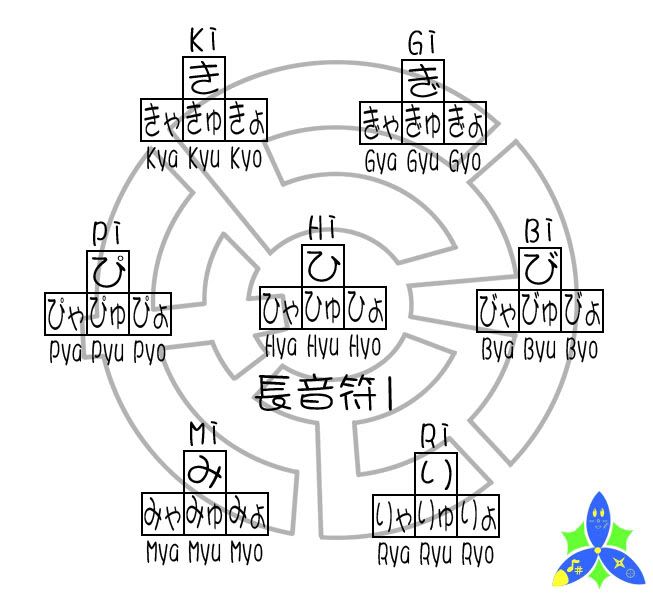
Up to now I've been teaching that each 仮名《かな》(Can't read it?)is given it's own distinct voicing and intonation. In addition to that, a small や, ゆ, or よ-this usage being called a 拗音-proceeding a 仮名 signifies a whole new kind of sound. To show what I mean let's take the reading of two 仮名, き and よ and say them at regular speed. Now remove the pause and read this: きょ. Now you can say the other 拗音 仮名 without a hitch(if you feel it's not right, say it faster until it does). 

The 仮名 that utilize 拗音 would be き, ひ(including when either゜ or ゛ are applied to it),み,り,し(including when゛ is applied to it)&ち. し. じ &ち are quite distinctive in that when paired with either 拗音 or a small え 仮名 they produce a whole new sound-those being しゃ(sha)しゅ(shu)しぇ(she)しょ(sho), じゃ(ja)じゅ(ju)じぇ(je)じょ(jo) & ちゃ(cha)ちゅ(chu)ちぇ(che)ちょ(cho). 


For futher assistance, here's a handy chart to the initial sounds and the brand new sounds

Thursday, February 25, 2010

Lesson 2.3: Dakuten and Handakuten

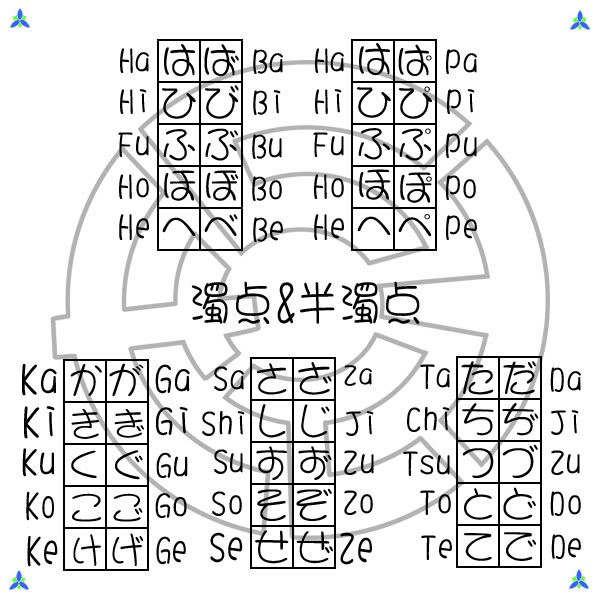
When learning the building blocks of writing Japanese, another thing to keep in mind is 濁点《だくてん》「゛」(Can't read it?) & 半濁点《はんだくてん》「゜」, also known respectively as てんてん(dot dot) and まる (circle) in informal circles. When applied to k, s, t and h 平仮名《ひらがな》 or 片仮名《かたかな》, their respective sounds change-k becoming g, s becoming z, t becoming d and h becoming b(with the exception of じ and ぢ, which are both pronounced 'ji'). ゛ are also applied to the 片仮名 ウ to signify v sounds in the written language「ヴァ(va)/ヴィ(vi)/ヴ(vu)/ヴェ(ve)/ヴォ(vo), respectively」 

Allow me to present a sample chart of some of the various changes.

k-sounds:か(ka),き(ki),く(ku),け(ke),こ(ko)
Now let's apply 濁点 and watch the the sounds change to this:
g-sounds:が(ga),ぎ(gi),ぐ(gu),げ(ge),ご(go)

With the above exceptions, the rest of the applicable 平仮名 follow the same pattern of addition and change in sound. For all the uses ゛ has, though,゜ only has one known one with the h family of 仮名, changing them from h to p sounds. Kinda strange, but at least it's only one more thing to learn with it, and less is always more, with how much you gotta learn.

If you need a bigger helping to grasp the changes, please turn your attention to
this chart