Donate to Red Cross Japan

The earthquake victims would appreciate your help more than you'll ever know(more resources can be found here).
Showing posts with label Koiyuki. Show all posts

Saturday, March 26, 2011

As Dense as a Rock (part 3): The Enriching Terms for Language Students

We spend our lives using statements like "He kicked me!" "Studying is hard work." or "I won't go if he's gonna be there, no way!" often without ever knowing what they are or how they work. While we are certainly capable of living full lives without this knowledge, in knowing these be become much more able to grasp it and use their principles to portray a certain image or feel(though the practice of naming is not without it's issues and limitations of how something can grow). That in mind, here are some of the terms to help you give greater depth and life to your statements and stories

Active Sentence
A sentence which describes an action from the agent's point of view.
What Does That Mean?
It talks about whatever the Agent’s doing, like when you tell your friends “Man, that Liang chick is chugging those beers like they were water. She’s on her 7th…8th…9th…I totally lost count”

Passive Sentence
A sentence which describes an action by someone from the viewpoint of someone else who is affected by that action.
What Does That Mean?
It talks about whoever was on the receiving end of whatever happens, often using Intransitive Verbs to provide a more detached point of view. It’s like when you ask your friend about the company softball game they played in and they say “We got whupped hardcore”

Auxiliary Adjective
A dependent adjective that is preceded by and attached to a verb or another adjective.
What Does That Mean?
One adjective is attached to the end of another adjective/a verb to give it a certain tone or intent, like when we’d say someone’s accident-prone (prone being the Auxiliary Adjective here). The same principle applies to Auxiliary Verbs

Causative Sentence
Sentences in which someone/something makes or lets someone/something do an action
What Does That Mean?
Depending on the sentence, they either let something happen or force it to happen, like when a workmate says “Yeah, you can borrow my stapler” or when you overhear someone say “Don’t make me break my foot off in your ass!”

Noun Phrase
A Word/group of words consisting of a single noun or noun and a number of optional modifiers
What Does That Mean?
It can be a group of something-like Pigs or Urbanites- or a subject + adjective(s)-like a rookie officer putting a Parking Ticket on that pricy Porsche. Altogether, it can let you talk in more detail about a subject, like when your friends ask you about Dale Carnegie’s book ‘How to Win Friends and Influence People’ and you say “That dated book is still pretty useful and informative”

Noun Clauses
A Word/group of words consisting of noun, predicate and/or a number of optional modifiers
What Does That Mean?
It’s much like a Noun Phrase, but allows for more detailed information to be brought into the conversation, so instead of saying of just talking about ‘That nerdy girl at the bookstore’ you can talk about ‘That nerdy girl you ran into yesterday at the bookstore’ Clauses themselves come in 2 kinds: Main (which can be used on its own, I.E. “That nerdy girl I know”) and Subordinate (which can’t, and need to work with a Main Clause to work proper, I.E. the ‘who I ran into’ part of “That nerdy girl you know was who I ran into”), which combine to make Complex Sentences

Conditional
A word, phrase, or clause which expresses a condition
What Does That Mean?
It says that something can or will happen if something/someone is a certain way, like when someone says “Yeah, I’ll give you some cash. When pigs fly” or a buddy tells you “If you weren’t so weird, people would talk to you more”

Simile
A figure of speech in which two similar things are compared.
What Does That Mean?
It’s something that lets you say one thing is like another to illustrate their common qualities, like in Forest Gump’s famous line “Life is like a box of chocolates: you never know what you’re gonna get”. Like others parts of language, it can be mean, funny, sad or anything else, based on the intent of the one using it.

Metaphor
A figure of speech in which a word for one idea or thing is used in its place or another to suggest a likeness between them
What Does That Mean?
It’s something that lets you say something or someone shows the qualities of something else or does something the way something or someone else would. This is demonstrated when you overhear someone say “People in our society are rats running through maze to get their piece of the big cheese” at a rally or when you’re at a pizza eating contest and your friend says “Wow, are those people or food processors over there?” Many sexual innuendoes rely on the metaphor and simile to express the intent of the message without directly using terms like ‘sex’ ‘penis’ and ‘vagina’(because that isn’t what classy folks do). Can be paired with a simile in the structure ‘A is B as C is D (along with similar structures)’ for more elaborate and thorough comparisons, like when you pass by a Hot Topic and your friend says “Rapcore is music like chess is a full contact sport” 

Tuesday, March 22, 2011

As Dense as a Rock (part 2): The Technical Terms for Language Students

The study of languages is often seen as dense and scary, and one of the greatest contributors to that are the use of terms few use outside the linguistic(study of languages, if you didn't know) circle. I know the first time I heard the word 'Agent' in the context coming up, my mind went near instantly to the Men in Black, and certainly nothing about someone who does something. Like I said before, once the series is done, the entries will be placed in a section on the blog and each one linked back to my Tumblr for individual consumption(and perhaps further analysis?). Nonetheless, here are a set of more technical entries to help you better identify parts of a sentence and improve your ability to seeking the intent of a statement and translate on the fly(which you'll want to improve as soon as possible not just for Japanese, but also for when you chat with friends and need to break down who did what quickly)

Agent
One who initiates and /or completes an action or an event.
What Does That Mean?
It’s whoever or whatever does something in a sentence, like when a rock (agent) smashes a window or when your friend (agent) pays for dinner

Subject
An element of a sentence which indicates an agent of an action
What Does That Mean?
It points out whom or whatever is doing something, like when you see your friend about to buy a $200 flannel shirt and say “You’re being an idiot! You can buy the exact same thing at Goodwill for $5!” (You being the subject pointed out here). This can be one thing/person, a group of 'em, an action, among many others, and is often mixed in with the concept of an Agent, the defining traits of each you could argue about at lengths for hours on end(and has been a topic of dispute among Linguists, or folks who study language, for generations)

Direct Object
The direct object of a verb is the direct recipient of an action represented by the verb.
What Does That Mean?
It’s who or whatever’s on the business end of an action, like when you see your irate classmate take their keys to the side of your history teacher’s car (the car here getting the brunt of the classmate’s rage)

Transitive Verb
A verb that requires a direct object.
What Does That Mean?
It’s a verb that needs something to act on, the lack of it leading to confusion. It’s like when you and a friend are hanging out at your house and you say “Cook.” as you glance at the frozen pizza on the table. Your friend, not seeing this glance, asks “Cook what?” unaware of what you want to them to cook, because you didn’t say what, exactly, you want them to cook

Intransitive Verb
A verb which does not require a direct object
What Does That Mean?
It talks about whatever the subject at hand was doing, in this case discussing it in a more detached and observant tone, like when your workmate asks you about what happened to your roommate last night and you say “Oh, Steve? Nothing much, he just worked overtime to cover for some girl he likes. When I got home and chatted with him, he fell asleep watching SportsCenter.”

Gerund
A verb that takes the place of a noun in a sentence
What Does That Mean?
It can used the same way you use a noun, the word’s exact appearance depending on language standards (English using verbs ending with ‘–ing’ as its Gerund). You’ll hear its use when someone says something like “Training is hard work” after practicing their 3 point shot at the gym or “Editing gets kinda lonely, sometimes” after they get off of a long day of working on transcripts and talk to their friend. When a verb is used as an adjective or adverb-like in ‘The Running Man’ or ‘A Broken Education System’- it’s called a Participle, and when it appears in its plain form-like when someone’s called ‘The One to Beat’ it’s called an Infinitive.

Predicate
Indicates action performed or existence expressed by the subject
What Does That Mean?
It points out what a subject does or what a subject is, like when someone sees a rusty van and says “Man, that car is old” or you see a sign at a protest that says “Corporations lie!”(Old and lie being the predicates here) It’s the presence of this and a subject together which makes a sentence a complete thought, in terms of proper grammar.

Pronominal
A verb/adjective which precedes a noun and modifies it
What Does That Mean?
It gives more detail to whatever you’re talking about, like when your friend tell you they managed to cook an edible chicken soup or a workmate calls your plan to try Skydiving sex a horrible idea. 

Saturday, March 19, 2011

As Dense as a Rock (part 1): The Foundational Terms for Language Students

  As a student of the Japanese Language(and budding teacher of both it and English), one of my biggest pet peeves about language learning material is that even the best ones expect the reader to know what a noun clause or a gerund is like the back of their hand and don't even give one single second to explain what they are or how one uses them in their native language. I was also guilty of this in the earlier versions of my lessons, and it's something I want to rectify as much as one dude with a blog can. When the series is done, these entries will be collected into one section of the blog+links to the further explanations of the individual entries on my Tumblr, but for now, let's starts with these base terms, the core of what gives any language it's skeleton;  its foundation.

Noun
A word that is the name of a subject of discourse
What Does That Mean?
It gives a name to people, places, things and ideas, Proper Nouns naming specific people, places, things and ideas. It’s much like the difference between saying you ate at a restaurant and saying you ate at Spago.

Pronoun
A word that takes the place of nouns in sentences (He, She, They, etc.)
What Does That Mean?
When the subject is understood, they’re employed to give more flow to what you’re saying and eliminate repetition. When you mention the name of a subject, you can use pronouns in its place so your sentences don’t sound stilted and unnatural. When it’s not mentioned when Pronouns are used, they add a sense of mystery to a statement(this is especially true for Japanese, which I will discuss in greater detail at a later date)

Verb
A word that expresses an act, occurrence or mode of being
What Does That Mean?
It gives us a way to describe the stuff we do to someone, whether it’s playing football, yelling at the top of our lungs or living it up. What makes a word a verb-or an adjective or noun, for that matter-depends largely on personal perception and how each person uses the language, making it just as like to hear someone say “Let’s green this place up” as you would hear “Are you gonna Lawyer up?”. (And there are different kinds of verbs to create different moods, which will be discussed later)

Adjective
A word that typically serves as a modifier of a noun
What Does That Mean?
They give color, definition and intent to the form laid out by nouns and the life infused by verbs. Instead of just saying you own a car, they let you say you own an American car; instead of just saying you love Metal, they let you say you love Heavy Metal; instead of just saying you’ve gained skill, they let you say you’ve gained unbeatable skill. The kinds of effect the different adjectives make are plentiful, and will be discussed later.

Adverb
A word that typically serves as a modifier of a verb, adjective or other adverbs
What Does That Mean?
They-in moderation-allow greater detail in describing something, so it lets you say the hair of a girl you just saw is platinum blonde or fiery red instead of just plain ol’ blonde or red.

Saturday, February 26, 2011

Take a Bow: Understanding How the Bow Works in Japanese Culture(the beginning of the Circle in the Square series)

They say people would rather croak than speak in public (and by ‘they’, I refer to the mountains of polls and studies pointing to this), but imagine you had to do that in the language of a culture seems like a fun-house mirror image of your own. That round peg in square hole conception is what I see in a lot of language learners, whether they’ve studied for 1 week or 1 decade. Contributing to this misunderstanding are those teaching the language as two separate things with minimal relation to each other. 


     While I give credit to those who’ve put in their time with the language and teach this way, I respectfully disagree with it, as I view each one to be vital to knowing the other. This is mind, I will now offer the knowledge I’ve gained so our circles can better fit in the so-called squares of Japanese culture, starting with an element closely tied to Japan: the bow.

Wednesday, February 16, 2011

Global Perception and You(part 4): The Worldly Curmudgeon


When you see the world through the eyes of a Worldly Curmudgeon, you’re letting everything this world has to offer come into you; all the joy, all the sorrow, all the pain, all the pleasure and all the points of view present in different ways of life. Each becomes worth equal consideration as they gain equal weight in our judgment, bringing our view full circle so we can see the complexity all of us are capable of the more we see how perception changes interpretation. How complex can people get? Let’s start with the people we meet in the city. 

Wednesday, February 9, 2011

Global Perception and You(part 3): The Issue Minded Prick

Have you ever met people who spit out stuff like this? ‘Bullfighting is Barbaric!’, ‘Our jobs are being shipped overseas!’, ‘The Gov’t spends as much on the military a day as they do on our libraries each year!’ and so on. Those are the people aware of the events driving cultures across the globe, and they’ve entered the teenage stage of subject study, people I refer to as ‘Issue Minded Pricks’. 

With Issue Minded Pricks, it’s not out of the ordinary for them to be seasoned students of both the language and culture. With more than a few years of study under their belt, they’ve had to establish what they wanna say, how they wanna say it and the process of keeping their skills sharp. They’ve seen beyond commonplace Japanese history and have learned things that would make your stomach do flips. These are what they refuse to be silent about, taking every viable chance to voice their stance. In fact, this has a strong presence within language studies due to the simple fact that every country has a deep history filled with bright times and dark days, Japan included.

Thursday, February 3, 2011

Global Perception and You(Part 2): The Smart-Ass Phase


The Smart Ass phase is where we start getting cocky about our language skills, thinking that our knowledge will impress people, even when it’s limited to stuff like ‘I like turtles’. This happens because many instructional books and classes coddle their students and stick to a less harsh learning environment. Why would this be preferred when these skills will be subjected to the fast pace of reality? 

Well, let’s face facts: No one is expected to get it right the first time in anything, including how we speak a language; doing so will only lead to finely crushed aspirations. As kids we got encouraged to keep at it by being rewarded or praised for each little thing we did right building towards the end goal, like if someone wanted their kid to pack their own lunch, they’d reward the initiative, then packing good ingredients, then crafting, wrapping and arranging the meal in a bag or lunch pail, then when they consecutively repeat the act on their own. 

     This is known as Shaping, a process that builds us up to seek out skills and knowledge in anticipation of showing it off and getting this kind of validation; this carries over into our language studies the more we find out about cultural nuances, word puns and so on-for example, that the word 絶倫(ぜつりん) is much like the English word Professional, which can refer to both someone proficient at what they do and someone proficient in the sack. 

Tuesday, February 1, 2011

Global Perception and You: The 4 Initial Stages of Growth in Subject Study(Part 1)

When we’re young, dumb and full of gumption, we learn something solid by doing something stupid; can’t learn to walk without a few falls, after all. That’s the way we gain experience, and the stages of life we all go through to gain it-baby, kid, teen and adult-repeat themselves with everything we pick up, especially when we learn a new language. In fact, it’s the stuff we do during and after all the growing that shapes us down to the core and-much like growing up-can be as confusing as visiting L.A., N.Y.C. or Tokyo for the first time and getting plopped into the city chaos head first. I know if I had someone there to smack some sense into my young punk skull, I would’ve had a solid grasp of the language and culture a whole lot sooner, instead of the elitist, “Japan is superior!” attitude that followed me around. 

    Now, because things worth our time are seldom easy, learning Japanese likely won’t be for you, so I’d like to offer my own experiences to help you track where you are as a student of a language (though-as is the preface for all the more subjective things I’ll be writing about here-you probably won’t like what I have to say) We’ll start this at the stage all of us start on at the outset: the Baby stage-or Newbie, if you prefer.

Thursday, January 27, 2011

Through the Open Window: A Manifesto for Approaching Language Study with an Open Mind

(Editor's Note: A Manifesto is 'a written statement declaring publicly the intentions, motives, or views of its issuer(Merriam-Webster)' which means what you're about to read is highly opinionated, more blunt in tone and likely to make you angry. Just a fair bit warning, since it's a bit long and you may not agree with what I'm about to say. And yes, I do expect you not to skimp, silly *laughs*)

The language we're raised with is shaped by grammar, colored by vocabulary & powered by culture, a word strongly tied to the stuffy and snooze-inducing aspects of our world-for example, the guy who turns his nose at those not into musicals or fine wines.

However, as culture can be manifested by a tea ceremony, so can it manifest through Causal Fridays & riding the bike trail to Border's with your friends every Saturday, all 3 a way of doing things cultivated through shared values & beliefs. When grammar, vocabulary & culture work in sync, our thoughts gain life & let us interact with the world how we want to, even if we've never seen it before.

You may be wondering how this relates to learning a language, and to that I say this: In understanding this you not only uncover the key to learning a language, but the key to learning it as your language.

Wednesday, December 8, 2010

Sowing the Seeds: Daily(or so) Drops of Info about Japan

One of the most important things I've learned about creating content for the online world is this: People(myself included) are given a torrent of new information every single day, and if you're not out there putting your best foot forward as often as you can, prepare to get lost in the tide. For me, this means giving people as constant a stream of valuable insight into the language and culture as I can without watering it down to match the standards everyone sets for their blog. With that, Sowing the Seeds was created, to help plant interesting new ideas about Japan and Japanese language while not bogging the pace down with getting longer form content just so. For your first taste of what's to come, here's an article interviewing Bilingual language teacher Kae Minami(from Japan Times). She discusses a good cross section of points about the country and it's language, including general pointers for those looking to pass their knowledge on(like myself), aspects of the language that make it unique-like the high level of context inherent in speaking it fluently-, and some advice for students/general life pointers. One of my favorites, and certainly full of info to help you on your way to building Your Japanese.

(special thanks to the article author, Judit Kawaguchi and the person who 1st tipped me off to it, Wendy Tokunaga)

Big Content Changes are a Comin'

Good to see you again! You may be wondering what big changes are coming, and to answer that, I would like to tell you a little bit about my experiences teaching Japanese and discovering what it means to teach well and with meaning. You know how they say nobody starts out perfect? That held very true for me when I first wrote my lessons up all those years, and didn't realize how patronizing and confusing they were until a few years and much more gained from my studies later. It hasn't been an easy road, and nothing worth while ever seems to be, but it taught me a lot about how to teach and presenting information in a manner easy to grasp. This is why you'll see some changes to the structure of the blog, such as lessons being categorized and little daily posts to shed some light on modern day Japanese culture. I'm certain they will help you strengthen your grasp on the language and culture, and perhaps show you a side of it you wanted to see more of, but didn't know it existed 'til now. Either way, stay tuned! You won't be disappointed, I assure you. In fact, here's a look at some of the subjects I'm doing research on for this overhaul:

Circle in the Square: Unstanding some of Japan's Inner-Cultural Workings

Sushi and Beyond: The Classic and Modern Flavors of Japanese Cuisine

A Divine Wind: The Japanese Role in Global Warfare

Everyday Magic: The Folklore and Fairytales of Japanese Culture

Wildstyle: An Introduction to Japan's Contemporary Culture

Naturythm: The History and Development of Japanese Entertainment

Slight of Hand: How to Speak Without Words

Across Oceans: Japan and it's Historical Intereactions with the World

Ordained by the Heavens: a Brief History of Feudal Japanese Society

Boys and Girls: Handling the Opposite Sex in Japan

Thursday, September 23, 2010

Lesson 3.1: Finding Your Way 'Round

Although everyone knows what happens when you assume, I'm sure many of you reading this many want to visit the island nation at some point in your lives so you can apply your knowledge of the language and culture, regardless of how much or how little you know. If you've ever traveled some place unfamiliar, like, say, a restaurant your friend said you gotta try that's tucked away among a mass of grey brick boxes and neon, you'll soon realize that a key piece of knowledge is how to ask for directions; for a place with as many grey brick boxes and neon as the cities of Japan, this is especially important to have with you.

Travel guides and phrase books do help, but I wouldn't rely too heavily on them, as they can and will get lost in the shuffle of going place to place to try and fit in as much as one trip allows. So if wanna you know which way leads to what you wanna see, set your pride aside, humble up and get ready to ask some directions. When the time comes, find someone friendly looking(gut instincts should be trusted on this part), approach and say the following:

失礼《しつれい》しますが 。。。(Can't read it?)
(Excuse me, but...)

To indicate you're looking for help, follow it up with this phrase:

助《たす》けてくれませんか。
(Could you lend me a hand with something?)
[Note: you can also use 助けて by itself to request assistance, such as when you see someone suddenly having a seizure/choking/going through other tough stuff, and need immediate help]

If you're not lucky, they won't know enough English/have the time to help you out and will either wave their hand in front of their face (like this) or say something among the lines of 難《むずか》しいけど。(It's a bit tough for me) or いそがしいけど。(I'm busy right now), or anything else, really, before they move on, implying that you gotta keep it moving and find someone else.

However, if they don't turn you down, ask one of the following:

 "(place) はどこですか。[note: since はis used as a particle in this instance, it's pronounced like 'わ'. More on this later]"
(where is [place]?)

Or

"(place)はどこでが有《あ》りますか。"
[where is (place) at?]

Tuesday, September 7, 2010

Lesson 2.5:促音(そくおん)Sokuon

In learning about Japan you've undoubtedly come across things and places with a double vowel in their name(One famous example being Hokkaido). How is that rendered in 仮名(Can't read it?), you may ask? With the help of a small つ 仮名, the term for it being 促音. It signifies a brief pause in speech while saying the word(Much like in the English words Poppa or Rabbit)-the technical term being a Germinate Consonant;the more proficient you are at speaking Japanese, the briefer it'll be  Let's take the name for an archetype in most anime-type stories as an example of how it's written:


つんでれっこ


*what a female is named, when they have a tough outer shell, but a tender inner being, closer to when we call a tough looking person a big softie*

It'll sound different depending on what 仮名 follows it(such as in the words 出席《しゅっせき》-the word for attendance-& ばっちり- used to express when something is done right or is right on the money), but the general principle is the same

Thursday, September 2, 2010

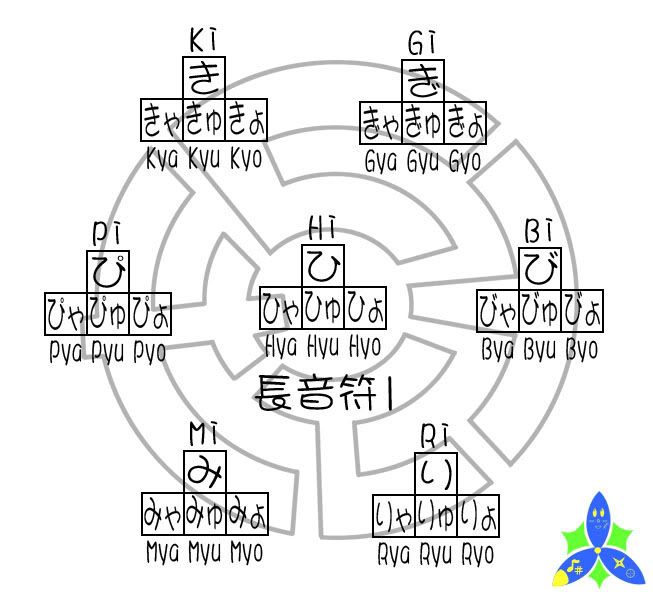
Lesson 2.4: 拗音(ようおん) & 長音符 (ちょうおんぶ) Youon & Extended Vowels

Up to now I've been teaching that each 仮名《かな》(Can't read it?)is given it's own distinct voicing and intonation. In addition to that, a small や, ゆ, or よ-this usage being called a 拗音-proceeding a 仮名 signifies a whole new kind of sound. To show what I mean let's take the reading of two 仮名, き and よ and say them at regular speed. Now remove the pause and read this: きょ. Now you can say the other 拗音 仮名 without a hitch(if you feel it's not right, say it faster until it does). 

The 仮名 that utilize 拗音 would be き, ひ(including when either゜ or ゛ are applied to it),み,り,し(including when゛ is applied to it)&ち. し. じ &ち are quite distinctive in that when paired with either 拗音 or a small え 仮名 they produce a whole new sound-those being しゃ(sha)しゅ(shu)しぇ(she)しょ(sho), じゃ(ja)じゅ(ju)じぇ(je)じょ(jo) & ちゃ(cha)ちゅ(chu)ちぇ(che)ちょ(cho). 


For futher assistance, here's a handy chart to the initial sounds and the brand new sounds

Thursday, February 25, 2010

Lesson 2.3: Dakuten and Handakuten

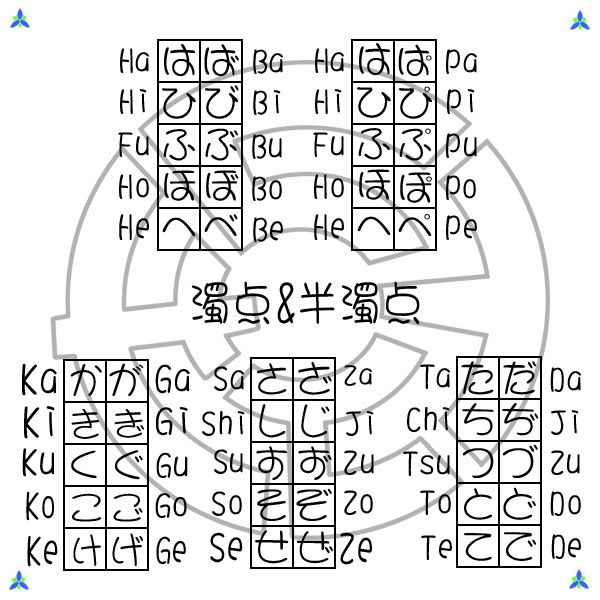
When learning the building blocks of writing Japanese, another thing to keep in mind is 濁点《だくてん》「゛」(Can't read it?) & 半濁点《はんだくてん》「゜」, also known respectively as てんてん(dot dot) and まる (circle) in informal circles. When applied to k, s, t and h 平仮名《ひらがな》 or 片仮名《かたかな》, their respective sounds change-k becoming g, s becoming z, t becoming d and h becoming b(with the exception of じ and ぢ, which are both pronounced 'ji'). ゛ are also applied to the 片仮名 ウ to signify v sounds in the written language「ヴァ(va)/ヴィ(vi)/ヴ(vu)/ヴェ(ve)/ヴォ(vo), respectively」 

Allow me to present a sample chart of some of the various changes.

k-sounds:か(ka),き(ki),く(ku),け(ke),こ(ko)
Now let's apply 濁点 and watch the the sounds change to this:
g-sounds:が(ga),ぎ(gi),ぐ(gu),げ(ge),ご(go)

With the above exceptions, the rest of the applicable 平仮名 follow the same pattern of addition and change in sound. For all the uses ゛ has, though,゜ only has one known one with the h family of 仮名, changing them from h to p sounds. Kinda strange, but at least it's only one more thing to learn with it, and less is always more, with how much you gotta learn.

If you need a bigger helping to grasp the changes, please turn your attention to
this chart

Thursday, February 18, 2010

Lesson 2.2: Loanwords

Katakana are for native Japanese words much like italics are for English, in terms of accenting and drawing attention to a certain word. They also, however, serve a secondary function for writing out words not native to their language(though sometimes you may also see them written out in Hiragana for style purposes, like here). Another thing to keep in mind regarding Katakana is despite what people-sometimes even native Japanese-may tell you, the word's root is not always English, as they have historically traded with and borrowed terms from many other countries, like France, Germany, Brazil, China, among many others, and the pronounciation should not assumed be as such.


Take for example the word they use for bread (パン(Can't read it?)[Pan]). If you were to assume the word was from English and thus pronounced it with an English accent, you'll undoubtedly draw stranger than usual stares, since other English speakers in the crowd might conjure up images of a cooking pan, or even a panning shot(both also what the word can refer to), instead of the bread you intended. Think about if someone pronounced the word Bologna as Bah-lone-yah (the approximate original Italian pronounciation) instead of how everyone who speaks English pronounces it (Buh-low-nee) if you want an idea of just how off putting that is. For anyone curious, パン's root in this context is actually Portuguese(pão), which is also where word for raincoat (カッパ[kappa]) oiginates from(capa).


So remember, when speaking with Japanese speaking friends of things outside their country, keep Katakana in mind and pronounce it through their accent-especially with mora in mind. This will also help you in getting what you want from Japanese establishments, even if how it's pronounced in Japanese seems nowhere near close to how it sounds in English-Vodka being pronounced as ヲッカ(wokka), for example. More on what the small つ(tsu) signifies in speech, as well as how to pronounce foreign words in through Japanese phonetics later.

Special note: steer well clear of outdated slang in your spoken vocab. You know how you look in pity at an old person that says, "Radical dude!" in an attempt to be with the kids? Unless you're trying to be ironic-which isn't impossible, but harder to do in a foreign language-that's how you'll look when you use super old slang, so be sure to keep your knowledge of it up to date by asking around before you pop in out in public. Also keep in mind slang isn't just limited to what everyone you know uses. You can also invent some of your own, the more you learn about the language, which I will cover in further detail later on.

Thursday, February 4, 2010

Lessons 2.1: Hiragana and Katakana

Imagine this scenario: you come into a country and can speak the language well enough to get around town. However when you need to read some of the signs, warnings, or various other important writings strewn around, you find you can't make out even the simplest of it's writing and find yourself confused and lost, trying to make heads or tails of what's in front of you. (take it from me: it's never a fun experience when you're actually looking for something)


Presumably you don't want this is happen to you, so you'll need to arm yourself with the building blocks of the written language; you need to learn how to properly read and write Hiragana and Katakana. A good place to start this process would be here- which will teach you how to install Japanese characters onto Windows, assuming you're using Vista or something like it- and here-which will show you the proper stroke order for each character. Practice writing them until you comfortable enough to do it from memory and be able to tell similar looking Hiragana and Katakana from one another, for that knowledge will come in handy when you get deeper into the language.

My personal recommendation? Get some grid paper and practice on it until it starts to resemble the examples. If it's a bit off, don't worry too much, as many Japanese natives have their own way to write them out, the same way people have different styles of handwriting in English. One way to help you remember them, outside of repeated writings until it becomes as natural as breathing, is associating them with their resemblance to every objects, such as in the cultural phenomenon Henohenomoheji

HOT TIP: the Katakana and Hiragana for Wi and We are pretty much irrelevant in modern Japanese society, so I wouldn't recommend putting too much effort into learning them unless you want to impress your Japanese speaking friends with obscure Japanese knowledge.


As for why one would need two different sets of the basic building blocks... (to be continued next lesson)

Thursday, December 3, 2009

Lesson 1.5: Reinforcing What you Learn

As I said before lessons are the foundation of Japanese learning and what you take in as your foundation will help you better understand what you need in learning the language. But what about when you want to apply your knowledge beyond an academic setting? Here are a few things you can use to help immerse yourself in the language and build on what you know. 

 
1. Children's books & Manga

Since many people who study the language are hoping to be able to read these, these will make an excellent way to introduce you to a couple key things. Firstly, that romaji pretty much goes out the window when you get into their media, and secondly that you become introduced to newer and newer terms and ways of speaking to incorporate into your Japanese arsenal. One title I would recommend for this purpose is Yotsuba&!, and from there any titles that contain furigana(smaller printed Hiragana written along the kanji words for the younger readers/people learning about the language to pick up on that kanji's reading and build upon). Once you feel content in your knowledge of Kanji and kanji compounds(more on those later on), go for the titles that contain no furigana to translate and read(which is often the case with newspapers, magazines and many doujinshi, or self published litreature, popularly referring to comics, but also allpies to books and other such products).


PRO TIP: Don't take on Newspaper reading until your language skill is considerably advanced, enough so to pass the higher levels of proficiency tests. You'll thank me when you're not pulling your hair out


Recommended kids stories: Take a look here to see a sampling

2. Consume other Japanese media

This includes reading books(again, seriously advanced language skills needed) listening to music, watching Dramas and movies and so on. Not only will this help you better understand the pace and pronunciation, but how intonation and other factors can affect how your words are perceived. I don't really recommend using anime for this purpose, however, as what is said there can be as subtle as getting slapped by a ham, and about as fruitful when used. For both previously mentioned methods, a good Japanese-English/English-Japanese dictionary is indispensable to have in your collection, so be sure to snag one ASAP.


Recommendations: Crunchyroll(for subtitled works) and KeyHoleTV(to watch it live from Japan as it happens, and even backed by the Japanese gov't). For dictionaries, I highly recommend the (totally won't fit in your)Pocket Kenkyusha Japanese Dictionary, as it gives you a written pitch guide for each word, examples, syntonyms(similar words), antonyms(words with an opposing meaning), and even teaches about about the culture. If you're an absolute beginner, the Oxfords Beginners Japanese Dictionary will serve you well.

3. Make friends with other learners/Japanese penpals

This will help you in not only learning, but using what you know in a social context. And in this day and age, there are many means to actually write to them and talk to them. So by all means, go on and use them and improve your language skills. No use in knowing so many words and terms if you don't know how to use them.


Recommendations: PenPal World, PenPal Net, Interpals, Japan Guide Classifieds, and My Language Exchange, among a plethora of others out there.

And for the most important step of all...

Monday, November 30, 2009

Lesson 1.4: Mora

For English we use syllables to write, read and pronounce each of our words as well as quickly pick apart any new words(like, say, the newly minted dictionary entry Bromance) or dialects we encounter. By comparison, Japanese pronunciation is much different, and instead of saying their syllables altogether in a constant breath, each one is said distinctly as a mora, or a unit of sound that helps us decide what gets emphasis in the words we say.

Take the word Mora, for example. Instead of pronouncing it as we might've learned from American style English(All a bit slurred together, IE MOR-a), we give each part of the world a bit of heft, pronouncing it a bit more like this (MOH-rah). Think along the lines of the way British English and Spanish is spoken, especially the Spanish rolled R's and you'll get even closer to Japanese style pronunciation.

Side note: Pronouncing Japanese through American style English accent is known in Japan as the 'Gaijin-san' accent, the term loosely translating as 'Mr Foreigner", and often communicates that your main knowledge of Japanese is through the heavily distorted versions seen in pop culture(such as in Banzai & The Karate Kid, no disrespect meant to those who do Wax On & Wax Off). It's viewed much the same way we'd view Japanese people pronouncing English through their accent, and I would assume is NOT something you'd like to be associated with. 

Saturday, November 21, 2009

Lesson 1.3 Elision

A key aspect to pronunciation is the concept of Elision. What is Elision? 
To put it simply, elision is a sound that's either a sudden stop in breath or drawn out, a bit like how we would say match, pack or bus, in terms of the end sound(each one respectively applying to sounds like chi, ki or su). 

The more elaborate explaination, according to Wikipedia, is that Elision "is extremely common in the pronunciation of the Japanese language. In general, a high vowel (/i/ or /u/) that appears in a low-pitched syllable between two voiceless consonants is devoiced, and often deleted outright. However, unlike French or English, Japanese does not often show elision in writing. The process is purely phonetic, and varies considerably depending on the dialect or level of formality." 

A few examples (slightly exaggerated; apostrophes added to point out elision): 

Matsushita-san wa imasu ka? ("Is Mr. Matsushita in?") 
Pronounced: matsush'tasan wa imas'ka 

roku, shichi, hachi ("six, seven, eight") 
Pronounced: rok', shich', hach' 

Shitsurei shimasu ("Excuse me") 
Pronounced: sh'ts'reishimas' 

Gender roles also influence how this is used in spoken Japanese. Doing it is generally seen as manly, especially the final u of the polite verb forms (-masu, desu, which you'll learn later on), where not doing it is seen as more feminine.  Doing it too much is generally viewed as obscure, while doing it wrong is seen as overly fussy or old-fashioned(like Grampa-style).