Donate to Red Cross Japan

The earthquake victims would appreciate your help more than you'll ever know(more resources can be found here).
Showing posts with label Japanese Lesson. Show all posts

Monday, September 27, 2010

Lesson 3.2: Being Specific

If you've ever asked someone for directions when you have no clue what the place looks like, you'd probably get super pissed when they just point to something in the distance and say "Over there". Since I'm assuming you'll want a better understanding of your path, the knowledge of what it is in Japanese will be needed. To start, let's work on your general sense of presence:

まえ(Can't read it?)
[front]

うし
[back]

うえ
[up]

した
[down]

ひだり
[left]

みぎ
[right]

If it helps, look around and point out each place in Japanese so it better sticks(or if you have a box, write the different directions on it). On the off chance, someone ever asks you for some directions, one helpful phrase may be:

"(place)の(direction)"
[(direction) of the (place)]

So if you want to tell a friend you're in front of the McDonald's, you can say "マクドナルドの前"At times, however, there may be other words that may help you find the right distance between you and your desired destination:

反対はんたい
[opposite]

向いむかい
[across the street]

そと
[outside]

なか
[inside]

あいだ
[between]

ちか
[nearby(meaning you can see it, but not quite touch it yet)]

そば
[right near(as in close enough to touch, or taze)]

よこ
[next to something different(like a piece of pizza near a small tub of ranch)]

となり
[neighboring something similar(1 house near another, 1 seat near another, etc )]

間 is used when describing when a location is between two others. Take for example this sentence:

(place)は博物館はくぶつかんえきの間があります
[(place)is between the museum and the station]

Thursday, September 23, 2010

Lesson 3.1: Finding Your Way 'Round

Although everyone knows what happens when you assume, I'm sure many of you reading this many want to visit the island nation at some point in your lives so you can apply your knowledge of the language and culture, regardless of how much or how little you know. If you've ever traveled some place unfamiliar, like, say, a restaurant your friend said you gotta try that's tucked away among a mass of grey brick boxes and neon, you'll soon realize that a key piece of knowledge is how to ask for directions; for a place with as many grey brick boxes and neon as the cities of Japan, this is especially important to have with you.

Travel guides and phrase books do help, but I wouldn't rely too heavily on them, as they can and will get lost in the shuffle of going place to place to try and fit in as much as one trip allows. So if wanna you know which way leads to what you wanna see, set your pride aside, humble up and get ready to ask some directions. When the time comes, find someone friendly looking(gut instincts should be trusted on this part), approach and say the following:

失礼しつれいしますが 。。。(Can't read it?)
(Excuse me, but...)

To indicate you're looking for help, follow it up with this phrase:

たすけてくれませんか。
(Could you lend me a hand with something?)
[Note: you can also use けて by itself to request assistance, such as when you see someone suddenly having a seizure/choking/going through other tough stuff, and need immediate help]

If you're not lucky, they won't know enough English/have the time to help you out and will either wave their hand in front of their face (like this) or say something among the lines of むずかしいけど。(It's a bit tough for me) or いそがしいけど。(I'm busy right now), or anything else, really, before they move on, implying that you gotta keep it moving and find someone else.

However, if they don't turn you down, ask one of the following:

 "(place) はどこですか。[note: since はis used as a particle in this instance, it's pronounced like 'わ'. More on this later]"
(where is [place]?)

Or

"(place)はどこでがりますか。"
[where is (place) at?]

Thursday, September 2, 2010

Lesson 2.4: 拗音(ようおん) & 長音符 (ちょうおんぶ) Youon & Extended Vowels

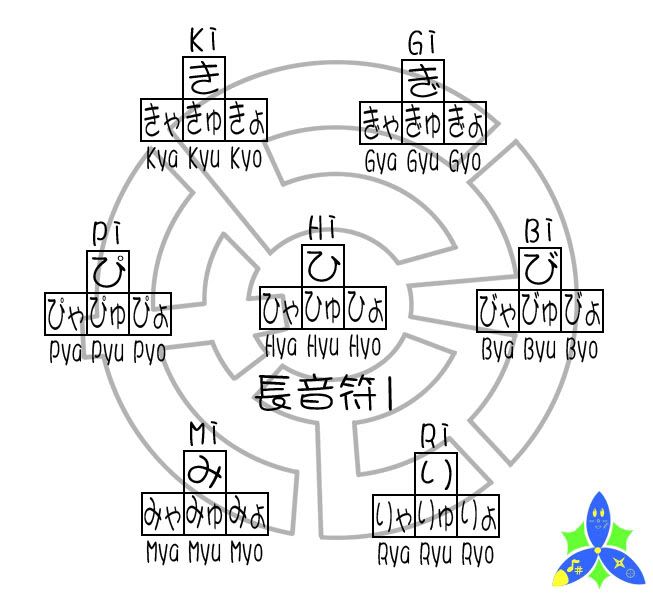
Up to now I've been teaching that each 仮名かな(Can't read it?)is given it's own distinct voicing and intonation. In addition to that, a small や, ゆ, or よ-this usage being called a 拗音-proceeding a 仮名 signifies a whole new kind of sound. To show what I mean let's take the reading of two 仮名, き and よ and say them at regular speed. Now remove the pause and read this: きょ. Now you can say the other 拗音 仮名 without a hitch(if you feel it's not right, say it faster until it does). 

The 仮名 that utilize 拗音 would be き, ひ(including when either or  are applied to it),み,り,し(including when is applied to it)&ち. し. じ &ち are quite distinctive in that when paired with either 拗音 or a small え 仮名 they produce a whole new sound-those being しゃ(sha)しゅ(shu)しぇ(she)しょ(sho), じゃ(ja)じゅ(ju)じぇ(je)じょ(jo) & ちゃ(cha)ちゅ(chu)ちぇ(che)ちょ(cho). 


For futher assistance, here's a handy chart to the initial sounds and the brand new sounds

Thursday, February 25, 2010

Lesson 2.3: Dakuten and Handakuten

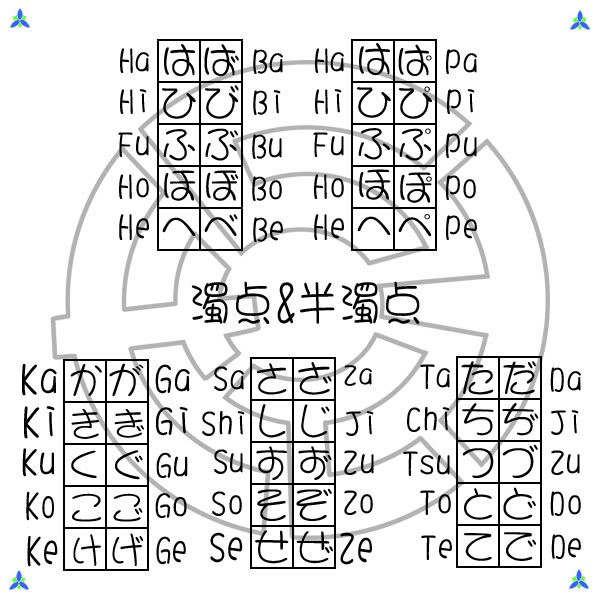
When learning the building blocks of writing Japanese, another thing to keep in mind is 濁点だくてん「゛」(Can't read it?& 半濁点はんだくてん「゜」, also known respectively as てんてん(dot dot) and まる (circle) in informal circles. When applied to k, s, t and h 平仮名ひらがな or 片仮名かたかな, their respective sounds change-k becoming g, s becoming z, t becoming d and h becoming b(with the exception of じ and ぢ, which are both pronounced 'ji'). ゛ are also applied to the 片仮名 ウ to signify v sounds in the written language「ヴァ(va)/ヴィ(vi)/ヴ(vu)/ヴェ(ve)/ヴォ(vo), respectively」 

Allow me to present a sample chart of some of the various changes.

k-sounds:か(ka),き(ki),く(ku),け(ke),こ(ko)
Now let's apply 濁点 and watch the the sounds change to this:
g-sounds:が(ga),ぎ(gi),ぐ(gu),げ(ge),ご(go)

With the above exceptions, the rest of the applicable 平仮名 follow the same pattern of addition and change in sound. For all the uses ゛ has, though,゜ only has one known one with the h family of 仮名, changing them from h to p sounds. Kinda strange, but at least it's only one more thing to learn with it, and less is always more, with how much you gotta learn.

If you need a bigger helping to grasp the changes, please turn your attention to
this chart

Thursday, February 4, 2010

Lessons 2.1: Hiragana and Katakana

Imagine this scenario: you come into a country and can speak the language well enough to get around town. However when you need to read some of the signs, warnings, or various other important writings strewn around, you find you can't make out even the simplest of it's writing and find yourself confused and lost, trying to make heads or tails of what's in front of you. (take it from me: it's never a fun experience when you're actually looking for something)


Presumably you don't want this is happen to you, so you'll need to arm yourself with the building blocks of the written language; you need to learn how to properly read and write Hiragana and Katakana. A good place to start this process would be here- which will teach you how to install Japanese characters onto Windows, assuming you're using Vista or something like it- and here-which will show you the proper stroke order for each character. Practice writing them until you comfortable enough to do it from memory and be able to tell similar looking Hiragana and Katakana from one another, for that knowledge will come in handy when you get deeper into the language.

My personal recommendation? Get some grid paper and practice on it until it starts to resemble the examples. If it's a bit off, don't worry too much, as many Japanese natives have their own way to write them out, the same way people have different styles of handwriting in English. One way to help you remember them, outside of repeated writings until it becomes as natural as breathing, is associating them with their resemblance to every objects, such as in the cultural phenomenon Henohenomoheji

HOT TIP: the Katakana and Hiragana for Wi and We are pretty much irrelevant in modern Japanese society, so I wouldn't recommend putting too much effort into learning them unless you want to impress your Japanese speaking friends with obscure Japanese knowledge.


As for why one would need two different sets of the basic building blocks... (to be continued next lesson)

Thursday, December 3, 2009

Lesson 1.5: Reinforcing What you Learn

As I said before lessons are the foundation of Japanese learning and what you take in as your foundation will help you better understand what you need in learning the language. But what about when you want to apply your knowledge beyond an academic setting? Here are a few things you can use to help immerse yourself in the language and build on what you know. 

 
1. Children's books & Manga

Since many people who study the language are hoping to be able to read these, these will make an excellent way to introduce you to a couple key things. Firstly, that romaji pretty much goes out the window when you get into their media, and secondly that you become introduced to newer and newer terms and ways of speaking to incorporate into your Japanese arsenal. One title I would recommend for this purpose is Yotsuba&!, and from there any titles that contain furigana(smaller printed Hiragana written along the kanji words for the younger readers/people learning about the language to pick up on that kanji's reading and build upon). Once you feel content in your knowledge of Kanji and kanji compounds(more on those later on), go for the titles that contain no furigana to translate and read(which is often the case with newspapers, magazines and many doujinshi, or self published litreature, popularly referring to comics, but also allpies to books and other such products).


PRO TIP: Don't take on Newspaper reading until your language skill is considerably advanced, enough so to pass the higher levels of proficiency tests. You'll thank me when you're not pulling your hair out


Recommended kids stories: Take a look here to see a sampling

2. Consume other Japanese media

This includes reading books(again, seriously advanced language skills needed) listening to music, watching Dramas and movies and so on. Not only will this help you better understand the pace and pronunciation, but how intonation and other factors can affect how your words are perceived. I don't really recommend using anime for this purpose, however, as what is said there can be as subtle as getting slapped by a ham, and about as fruitful when used. For both previously mentioned methods, a good Japanese-English/English-Japanese dictionary is indispensable to have in your collection, so be sure to snag one ASAP.


Recommendations: Crunchyroll(for subtitled works) and KeyHoleTV(to watch it live from Japan as it happens, and even backed by the Japanese gov't). For dictionaries, I highly recommend the (totally won't fit in your)Pocket Kenkyusha Japanese Dictionary, as it gives you a written pitch guide for each word, examples, syntonyms(similar words), antonyms(words with an opposing meaning), and even teaches about about the culture. If you're an absolute beginner, the Oxfords Beginners Japanese Dictionary will serve you well.

3. Make friends with other learners/Japanese penpals

This will help you in not only learning, but using what you know in a social context. And in this day and age, there are many means to actually write to them and talk to them. So by all means, go on and use them and improve your language skills. No use in knowing so many words and terms if you don't know how to use them.


Recommendations: PenPal WorldPenPal NetInterpalsJapan Guide Classifieds, and My Language Exchange, among a plethora of others out there.

And for the most important step of all...

Saturday, November 21, 2009

Lesson 1.3 Elision

A key aspect to pronunciation is the concept of Elision. What is Elision? 
To put it simply, elision is a sound that's either a sudden stop in breath or drawn out, a bit like how we would say match, pack or bus, in terms of the end sound(each one respectively applying to sounds like chi, ki or su). 

The more elaborate explaination, according to Wikipedia, is that Elision "is extremely common in the pronunciation of the Japanese language. In general, a high vowel (/i/ or /u/) that appears in a low-pitched syllable between two voiceless consonants is devoiced, and often deleted outright. However, unlike French or English, Japanese does not often show elision in writing. The process is purely phonetic, and varies considerably depending on the dialect or level of formality." 

A few examples (slightly exaggerated; apostrophes added to point out elision): 

Matsushita-san wa imasu ka? ("Is Mr. Matsushita in?") 
Pronounced: matsush'tasan wa imas'ka 

roku, shichi, hachi ("six, seven, eight") 
Pronounced: rok', shich', hach' 

Shitsurei shimasu ("Excuse me") 
Pronounced: sh'ts'reishimas' 

Gender roles also influence how this is used in spoken Japanese. Doing it is generally seen as manly, especially the final u of the polite verb forms (-masu, desu, which you'll learn later on), where not doing it is seen as more feminine.  Doing it too much is generally viewed as obscure, while doing it wrong is seen as overly fussy or old-fashioned(like Grampa-style).

Sunday, November 15, 2009

Lesson 1.2: Reading the Air

In Japan they sometimes use abbreviations of their words as rendered in Romaji, such as JK[Joshi Kousei(female HS student)], IW[Imi Wakaranai(don't understand the meaning) and KY[Kuuki o Yomenai(cannot read the air, in this sense meaning the situational context)]. This manner of speaking is dubbed KY Go(K.Y. speak, rooted from the aforementioned abbreviation), and ties into arguably the most important skill you'll need in speaking the language: reading the air and reacting appropriately.

 
The key point of this isn't simply stating what you want them to hear, but to sit, listen, and relate what they've told you at their level. This factors not only into what is stated, but also what is not, including reading a person's tone of voice, body and facial language, along with appropriately recalling any information they may reveal to you at some point. Of course, as one can completely fail to read the air, one may also over analyse it and read it wrong, so remember to find your balance and read the info you need to make the correct judgment of a situation.

 
Also keep in mind how a person acts in a public setting(called Tatemae, or public face) is often much different from what they truly think at the home, and how they act in a private setting(called Honne, or true face). Also bear in mind any social obligations they have to their company, friends or family, and you to them(called either Giri[which involves balancing the personal life with any obligations their way of life calls for] or Gimu[where when nothing else will do to repay something, loyalty is given in it's place. Also the blanket term for both concepts, when bringing them up in discussions. More on both later on]). Once you have a grasp on these, you can better read situations presented to you, and have the right action ready to go(there's more you need to know, and that will covered at a later date).

Friday, November 13, 2009

Lesson 1.1: Laying Down Some Basics.


First of all, allow me to be clear about one very key point in learning Japanese...


LEARNING SOLELY FROM ANIME/MANGA/DORAMA/J-MUSIC=NO 


What you learn from there is either incredibly archaic, or way overblown and will make you look strange when used in a casual conversation. Imagine if someone you knew spoke like they were in a cartoon or a soap opera every time they spoke.  If entertainment media is all you learn from, that's what you're gonna sound like; not very inviting of conversation, if you ask me. Remember, lessons are the base, and media supports and reinforces what you're learning, never the other way 'round.


Moving on, though, like any other student of any other subject, you must be willing to learn from both the lessons offered and the stumbles you'll encounter; because if there's one thing you'll do a lot of it's stumbling. (for a while your Japanese may sound like this, and that's ok. There are no mistakes, only variation, as the Zen saying goes.)